Injury Proofing Your Year
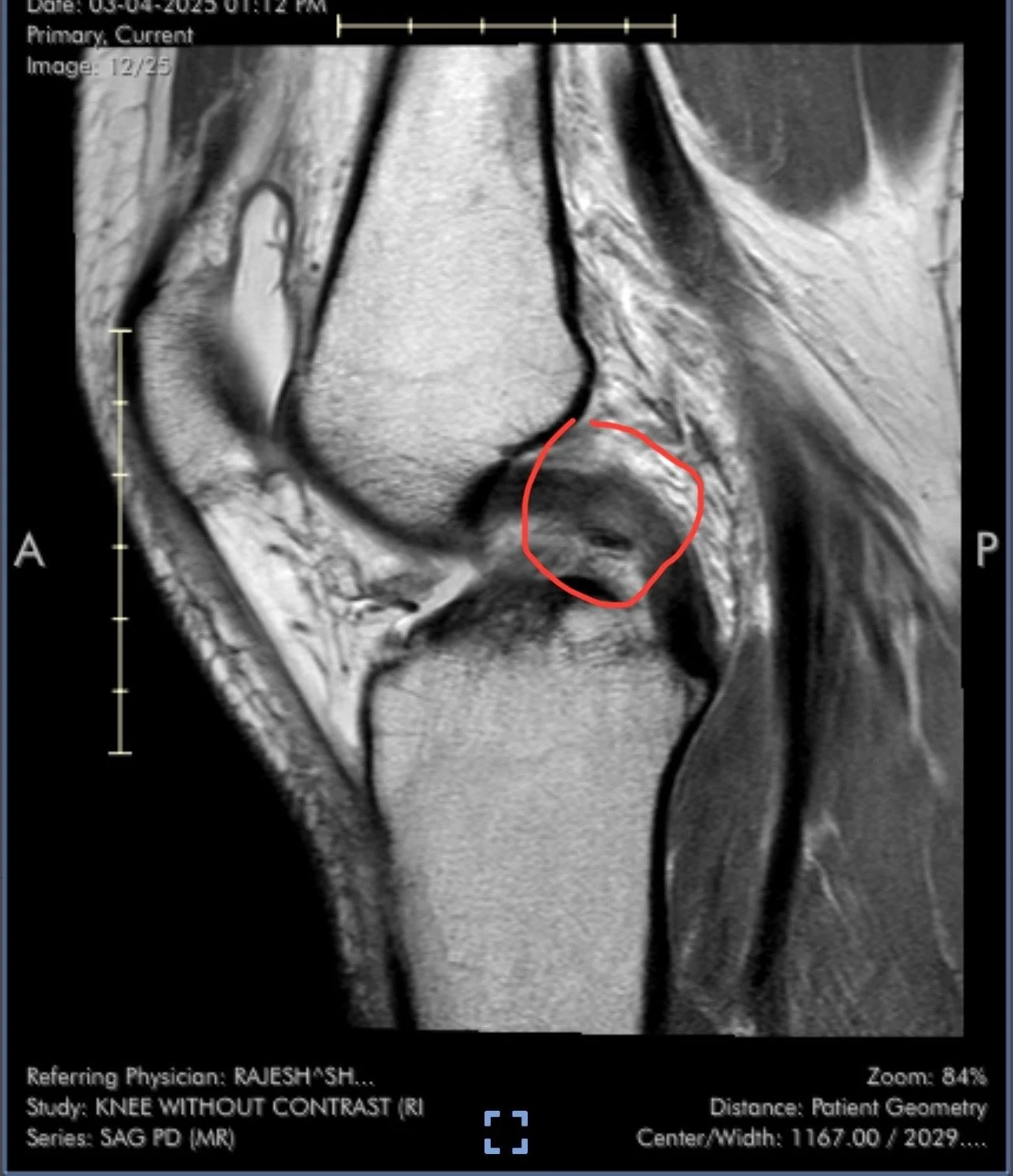
Partial PCL Tear submitted by Pole Plus Instructor Starr
Happy poling,
My dear pole babies. Now, I know with the new year comes a litany of tricks we want to learn, transitions we want to embody, as well as goals and go-get-’em attitudes we want to capitalize on—but let’s make sure that as we are planning a whole year of pushing ourselves, we also plan the pouring into ourselves that needs to go with that. So much of our life as dancers, athletes, and aerialists is spent training and conditioning the tricks we want, but if training isn’t done with rest, recovery, and supplementation in mind, we can end up doing more harm to our bodies than good. Last year, we spent some time talking about self-care practices for pole dancers that could help us maximize our recovery time without taking us away from our desire to stay active. Today, I am coming to talk to you about injury-proofing your year—how you can use similar self-care practices, smart nutrition planning, and a few other tips to train your hardest without worrying about injuries and unplanned physical breaks.
First, injury-proofing your year doesn’t mean training less or slowing down; it’s about giving yourself more room to move. It’s about creating more time, more freedom, and gaining more strength. Pole can be a lot on the mind, body, and spirit. It is intense, athletic, and artistic all in one, and most of the injuries that come from pole are due to overuse, under-recovery, or inconsistent preparation (yes, I’m talking to those of you who like to skip the warm-up). The key to injury-proofing your entire year is changing your perspective. We want to swap hustle culture and mentality for longevity—basically, dance like you want to be dancing when you’re 80. That means we have to focus on intention, consistency, and discipline.
When planning on injury-proofing your year, it is paramount that we focus on building strength with intention and not impulse. This means training to be strong enough for a move instead of struggling through it. Training to be strong enough for a move means you understand the underlying mechanics of what you are trying to do, the muscle engagements, and the amount of control or stability you will need to accomplish that trick. Basically, you have to inner-stand what it is you are trying to do so you can train for it. Some resources that really help with understanding the underlying anatomy behind the pole tricks we do are The Pole Physio and The Pole PT. Both are great resources because they have hours and hours of content (blogs, YouTube videos, Instagram posts, etc.) highlighting not only the anatomy for most pole moves, but also the prerequisites each trick requires, as well as trick-specific conditioning to utilize. This is how we build strength with intention. We focus on making sure we understand what is needed before we do it instead of just F-ing around and finding out.
The second way we ensure our year is injury-free is to warm up like we mean it. Most pole dancers don’t warm up enough. Warming up includes more than just getting the body warm and ready to move—it also means preparing your muscles to engage. A lot of times you’ll notice your instructor might add specific conditioning in your class. This isn’t just because they are trying to tire you out before class; it’s because they are activating those specific muscle groups to get them ready to do what they need to do. In addition to increasing body temperature and muscle activation, a good warm-up routine also highlights joint mobilization and gradual load progression. There are so many great pole-specific warm-ups available to you—I will include some links at the bottom of this article for quick grabbing, so some of us (you know who you are) can stop hopping on the pole as soon as they get into the studio.
The next step in injury-proofing your year is to schedule rest before your body takes it by force. There are two different types of rest: active rest and true rest. Active rest uses light movement to encourage blood flow and aid muscle repair. These are activities such as yoga, walking, swimming, etc.—any activity that keeps the body moving, but more gently than your primary practice. True rest refers to complete rest from any type of movement. This is useful for deep healing or for when someone is extremely exhausted or healing from an injury. This type of rest is also useful for mental recharge or burnout recovery. Both types of rest are beneficial, especially for pole dancers.
We tend to use the same muscle groups when we pole a lot. Active rest is beneficial because we can keep moving toward our goals without overusing the muscles we need for pole, giving heavily loaded muscle groups like our shoulders a break. True rest is also beneficial for pole dancers for the same reason. Muscle strength and growth are achieved in the body during rest periods. What happens in the body is that during intensive exercise, micro-tears are created in our muscle fibers. During rest, the body repairs these tears, rebuilding the muscle to be larger and therefore stronger than before. If we train endlessly, we rob our muscles of rest periods, and those tears never recover. Some signs of overtraining include grip fatigue, reduced range of motion, longer soreness windows, and emotional irritation or burnout. For this reason, I strongly recommend establishing a rest rhythm or intentional rest practice in your training routine. Plan for 1–2 days off every week, and also plan for a deloading week every quarter—an entire week where true and active rest are prioritized and no pole is practiced.
Last, but not least, the final step to injury-proofing your year is listening to your body. The body, as a system, has built-in alarms that alert us to multiple issues. To injury-proof your year, you have to be more than proficient at identifying these alarms, understanding what they mean, and listening to them. These could be alarms for not eating enough food (a growling stomach) or increased muscle tension (tense shoulders, wobbly legs). Other signs to look for include pain or inflammation, which are both signals that something needs healing. Learning to recognize and listen to signals like these helps us address potential dangers before they become injuries and unfortunate circumstances. As dancers, our bodies are just as important to us as a surgeon’s hands or a mechanic’s tools. The better we take care of them, the longer we get to do what we love most.
Happy poling,
F8