The Artistry Era: 5 Ways to Find Your Signature Pole Style in 2026
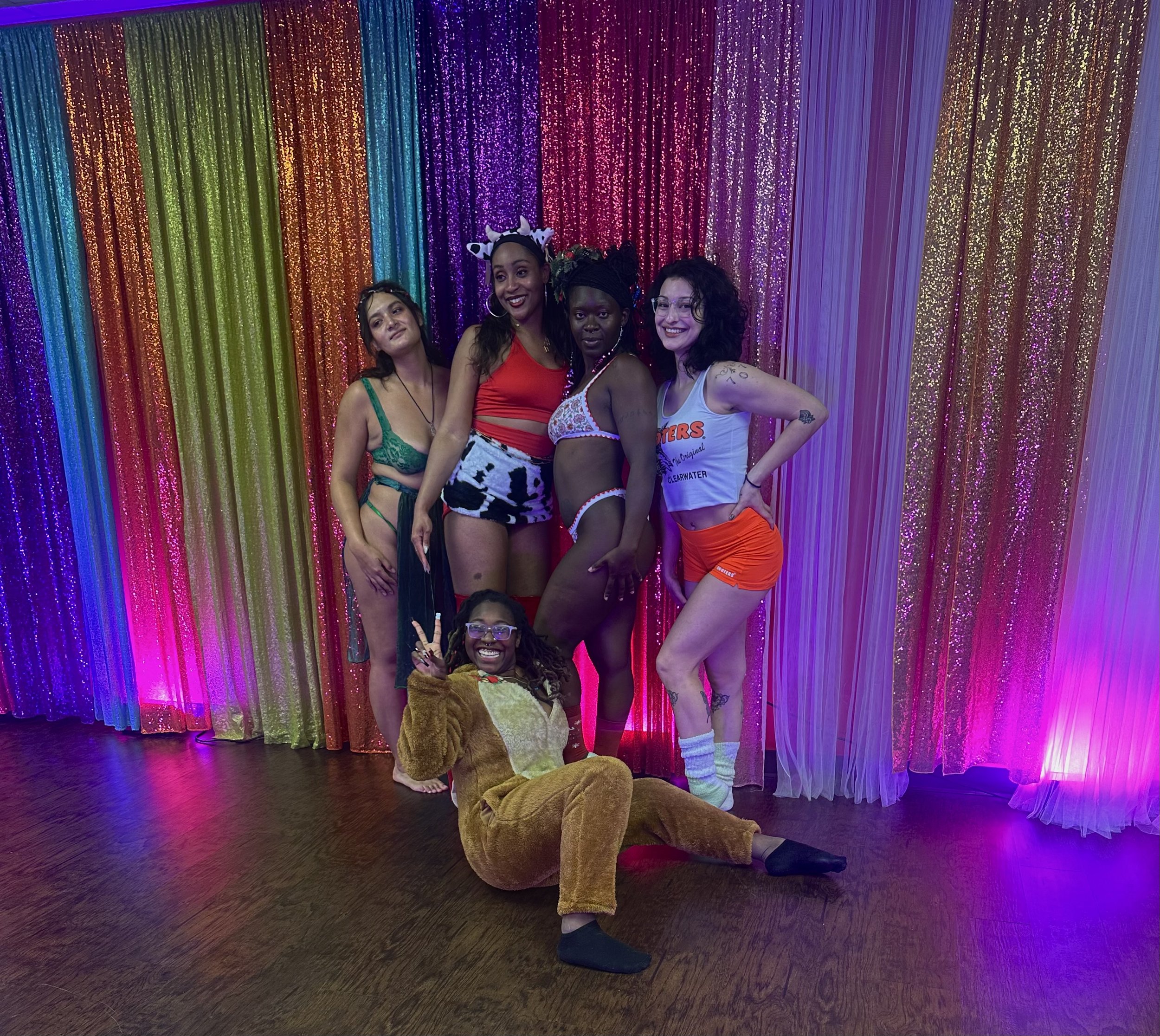
Happy New Year my pole babies! I am so grateful to join you here at The Pole Plus Studio Blog for another year of guidance, great conversation, a movement space and studio that EATS, as well as a pole practice that feels intentional, peaceful, challenging and FUN! Once again to reintroduce myself and get us started, My name is F8 (like a V8 energy drink), and I’m an instructor here at Pole plus studio. I teach all levels from Intro to Pole to Level 4! I’m also a PSO Level 4 - Entertainment Gold medalist, A Western NY Advanced Freestyle First place Champion and a multi-apparatus instructor (Lyra, Yoga, and Hammock). I specialize in the interconnectedness of movement and transferring the knowledge learned from one movement style into another and I am so excited to talk to you today about how you can find your Signature Pole Style this 2026!
Now before we get into the nitty gritty of 5 ways in which you can find and build your styles, let’s talk about the difference between style and skill. Although your skill level can influence your style they are not the same thing. Your style refers to how you naturally express yourself through movement. It is how your musicality, personality, emotional world, life experiences, cultural influences and body preferences intertwine. It’s the flavor, the attitude, the texture and the choices you make in between your tricks. Skill on the other hand is what your body is capable of doing. Your literal technical ability, strength, coordination, flexibility and control. These are all things you can train over time. whether its inverts, spin, climbs , transition etc, Skill is learned through repetition, conditioning and technique training. Anyone can acquire skill with time and practice but style is usually felt before it’s seen. Skill says “I can do this move.”, Style says “This is the way I do it”.
1. Building a movement Vocabulary
Your movement vocabulary is NOT the collection of shapes, transitions, gestures etc that you can already do. It is the amalgamation of all of which calls your attention naturally, all which you naturally gravitate towards. All the posts, routines combos that instinctually make you go ”Ooooooh, i wanna learn that”. Like the words you use before you ever form a sentence, the words you accent, or the exclamations you add, when you intentionally build your movement vocabulary, you can exponentially increase your artistry. A good place is to start is with what already feels good! Your body already has its preferences, some dancers do well with big expansive flexible shapes. Other dancers prefer floaty airy transitions or sharp quick hits/ dynamic movements. Pay attention to what you repeat without thinking about it, the shapes you gravitate towards and when you freestyle and which transitions do you have that already feel effortless. Next you wanna identify 6-10 moves that already make you feel gooey. Maybe that’s a go-to spin or shape, maybe that’s a hair whip, heel clack or body roll. It can be absolutely anything as long as it feels like home to you! This will be the foundation of your style identity and the guide to creating consistency and consistently. Now you want to find variations of the moves you’ve already identified, think of tempo. How it looks slow vs fast, also soft vs sharp, minimal vs exaggerated, sensual vs athletic. Find as many variations as you can and see how you can add them to your vocabulary. Do not restrict yourself or make your training too rigid, take classes outside your comfort zone, freestyle to music you normally wouldn’t choose, or mirror a dancer you admire and then make it yours. Add these new explorations in your vocabulary through play not pressure. Once you have your vocabulary built try writing sentences. Try connecting 3-5 of your signature moves that you’ve chosen, or add a new unfamiliar move . This is where your vocabulary becomes your voice, try new things, fail, and try them again. Your style is only limited by your imagination. Revisit your vocabulary list every few months and see what no longer fits what continues to feel good and what you would like to add.
2.Utilizing music, emotion, and character work
Artistry like i stated before exists at the intersection of so many different personal nuances. But it also exists at the intersection of sound, emotion and identity. Learning to use music, emotion and character work intentionally in your movement is the difference between choreography that feels rigid and choreography that feels like storytelling. This is where Pole specifically transform from fitness and athleticism to expression and poetry. Music is your first dance partner, before the pole, before your heels, your music is the foundation of your identity and style. It isn’t just something you move with, it’s something you move with in. So instead of treating a song like back ground noise I’m going to encourage/ show you how to respond to it like a conversation. The first thing to do when using music intentionally is to listen for the layers. Let the bass line ground you. Pair your accents with the percussion instruments (drums, hits etc), let the space between your movements( your flow) to be linked with the melody and use the silences to build tension. Let the music change you, let it choreograph your breath before it choreographs your movement. Ask yourself, ‘where does this song want me to melt?’ ‘Where does it want me to hit’ ‘where does it want me to pause?’ And ‘ where does it want me to let go?’
Emotion is the fuel behind every shape. It gives moment purpose and turns the simplest spins into the most meaningful expressions. But to use emotion as a tool you have to be willing to not only sit with yourself but also listen. Ask yourself, ‘What am i trying to say today?’ ‘How do I feel?’ Your body will tell you the truth even before you have the words. Is there a tightness in your chest, are you feeling heavy, are you grieving? Let your emotions be the color you add to your choreograph and try using it to dance your combo, Dance it sad, then dance it happy. Dance it with seduction, with power or with curiosity. Use the same piece of choreography to write a completely different story each time. Be specific with your feeling go deeper than the surface for example sexy is the surface but desire, tease, claiming, longing, devotion and confidence are all specific subparts of feeling sexy
Character work is your artistic superpower. It focuses your movement like a laser and gives it a point of view. Choose a character archetype, there are many (the siren, the villain, the lover etc) and get started by asking character questions. How would your character touch the pole, look at the floor, walk, pause breathe? These questions take your steps and add narrative to them add texture. When you’re unsure of your next step your character becomes the glue that holds your piece together. You may not know what’s next but your character does. Together music gives you the rhythm, emotion gives you the rhyme and the reason and character gives you identity and context to transform choreography into a mind blowing artistic experience.
3.Exploration over Perfection
Perfection is the place where artistry comes to suffocate. Exploration is where life is found. So in 2026 we are shifting from dancing to look good and into dancing to feel good. Stop performing for approval and start experimenting with curiosity. Artistry requires permission to be messy. It’s easy to hide the parts of your movement that feel unpolished but thats where YOUR style comes into fruition. When you allow yourself to look “stupid” or stumble or fail and rework you create space for discovery and give creativity the space it needs to thrive. So instead of asking “does this look right” ask yourself “what else can this become” treat your body like a hub of creativity not a test you need to pass. Sometimes that exploration means that your technique will be left behind and that is okay. Bend those lines, let your weight shift. Let it happen and let it teach you something new. If you’re feeling stuck in your exploration try experimenting with prompts. They can remove the pressure and let your brain explore pathways it normally wouldn’t explore. And this doesn’t mean dont focus on technique it means learn the rules, learn your technique but then break it on purpose. Rebel out of mastery. Your artistry is going to live in between your tricks shapes or predetermined destinations. It’s going to sit in your transitions, your pregnant pauses and in your breath. Perfectionism is going to silence your artistry but exploration will give it room to grow.
4.Your Body Holds a Story ; Let it speak
Every dancer, every person has a personal archive, a library of emotions, victories, heartbreaks and lived moments that shape the way they move and experience the world. Your artistry is not created from scratch it is created from the stories that make up your personal archive. Everything you have survived, everything you feel, love and hold dear. Your artistry becomes its most powerful when you stop dancing like the dancer you think you should be and dance like the dancer you are. Let your truth guide your movement. Let the tension from your old wounds and the triumph from your past live in the curvature of your spine. Let the softness you’ve felt from love or the heaviness you hold from past grief influence how you breathe and when you dance let the instinct of survival inform every step. Let your history dance with you. When you dance your story you stop being a performer and become a story teller and that is the heart of your Artistry Era
5.A guided exercise for discovering your personal aesthetic
Your personal aesthetic is the visual personality of your movement practice. It is the ambiance you wrap around your performance that makes you recognizable before you’ve even taken a step. This exercise is designed to help you identify and solidify what yours looks like. First you’re gonna grab a note book, this exercise should take 15-20 minutes to complete. Don’t overthink
Step 1 : choose 3 words that describe your movement style. These can be descriptions of some of the words from your movement vocabulary earlier. A good question to ask yourself is… “when i move without thinking, i feel…”
Step 2: choose 3 words that describe how you want to move; also from your movement vocabulary. A good prompt to follow is “ the most evolved version of my movement feels like…”
Step 3: we are going to combine both of those to use as a guide towards your personal aesthetic. Let’s say you chose fluid, grounded and moody for step one and powerful bold and mysterious for the second step we are going to combine both of these to find music that embodies these adjective and let it guide our movement.
Step 4: once you’ve found a song that embodies your aesthetic guide above you’re going to freestyle and record it. Afterwards you’re going to watch it a few times and extract your signature elements. 3 shapes that felt like you, 3 transitions that felt natural, 1 moment where emotion took over and 1 moment your body did something unplanned. When watching the video over i want you to think about what you are already wearing, what was easy to do what was hard? Were you fully clothed and did that make it hard to stick to the pole, were you in a 2 piece and did that make crawling on the floor harder? Did you like how you like how your hair was moving should it have been up or down? Imagine you were on stage right now doing this freestyle, what would your makeup look like?
Step 5: lastly we are going to use all the information we have compiled to do an intensive Pinterest search. Using your signature elements and aesthetic guides from step 1 -3 we’re going to look for outfits make up looks that embody all of what we’ve created, for example, “moody powerful outfits that are easy to move in, or mold mysterious make up looks that embody fluidity” this step is why its important to get as specific as possible with your adjectives so that your search and ultimately the cumulation of your aesthetic persona can be all the more easy.
So all in all, your style is not something you force, it is something you discover. It’s already imbedded in your being, in your story, in your practice just waiting for you to open the door with curiosity, honesty and intention!
Happy Poling